Posts

pH Threshold as a Predictor of Endurance Running Performance
Image
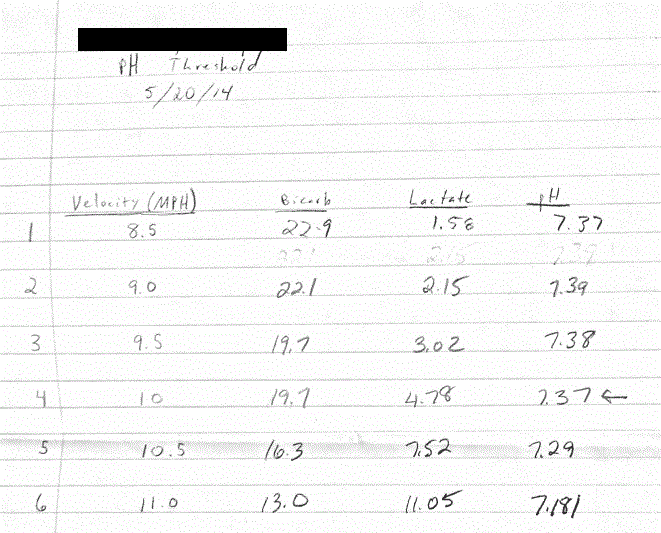
Lactate and pH Lactate threshold as a percentage of VO2max has long been associated with distance running and cycling performance. But lactate is not a cause of fatigue. Rather, the accumulation of lactate is an indication of what's occurring. Lactate can accumulate without a change in muscle pH. In fact, lactate production prevents or delays changes in pH. So, could pH threshold be a more sensitive indicator of performance capacity than lactate? Below is data and a graph from a pH threshold test conducted on a treadmill in a lab. From the graph, you can see the lactate threshold falls at roughly 9.5 mph or 6:19/mile. Here, we saw an increase from 3.02 mmol/L to 4.78 mmol/L (+1.76 mmol/L). But note that blood pH did not change from 9.5 to 10 mph (7.38 to 7.37). But, pH did fall between 10 and 10.5 mph. This demonstrates that even though lactate starts accumulating, pH does not necessarily change. In theory, an athlete should be able to maintain a pace in that w...

Phosphatidylserine: Where's the Research?

Seeking the truth? Do not strive to prove, but to disprove. From my perspective, the increasing popularity of phosphatidylserine (PS) as an ergogenic aid is entertaining. When a new supplement hits the market with claims of improved performance, increased this, decreased that... The "gurus" want a piece of the action - they jump on the bandwagon; like they've known all along. Now they're giving dosing protocols, touting the supposed benefits of "the next big thing." PS is not a new supplement - you can find research on PS and exercise dating back to the 80's. It used to be obtained from bovine cortex (cow brains), but after the mad cow disease scare, it has more recently has been extracted from soy (Jager et al., 2007). If you rely on the gurus' supplement reviews or forums for your nutrition information, you may be on your way to the nearest supplement shop. But before we get carried away, I have a few thoughts and questions about PS: ...

Altitude Acclimation: Potential Application for Improved Exercise Economy

The "big three" determinants of endurance exercise performance are VO2max, pH threshold (sustainable pace) & exercise economy. We could also include anaerobic capacity and maximal speed/power as components that could determine the outcome of a sprint finish. The importance of running economy has been documented many times, and is often regarded as a strong predictor of performance, especially between individuals with similar VO2max values (Saunders et al. 2004; Daniels 1985). I've written on training for economy in the past. Training strategies such as hill sprints, resistance training, plyometrics or high intensity intervals have all shown improvements in economy.  In two studies, Saunders et al. (2004, 2009)  have also shown improvements in running economy following altitude acclimation. A study by Czuba et al. (2014) produced similar results in elite level biathletes and Latshang et al. in mountaineers (2013). Potential mechanisms? Stays at altitude are...

Training for Endurance: Progressive Recruitment

Image
I read  an article on VeloNews  a while back describing how many cycling races are won and lost in the final hour or minutes of racing. And this is generally true, it often comes down to who can sustain the highest power output in the final push to the finish after three, four, or five+ hours in the saddle. Rationally, it makes sense that being able to delay fatigue and enter that last hour of racing with a greater capacity for work will enable an athlete to finish faster. Many of this spring's one day classics have served prime examples - those that produce the greatest amount of power in the end will prevail. Take this years's  Milan-San Remo  for example: after 6 hours of riding, the race hits a series of small climbs before a sprint to the line. This year, it was Alexander Kristoff in the final sprint (after nearly 7 hours on the bike) who took the win - out-sprinting the likes of Mark Cavendish and Fabian Cancellara. When asked about the finish, Kristoff acknowl...

Are we on a Quest for Mitochondria or a Quest for Maximized Performance?

What I don’t understand is when I see teams and athletes pursuing marginal gains and ignoring the basics and fundamentals of sound training. There is no sense pursuing the last 2% until you have taken care of the first 98%. -Vern Gambett a As science advances, we identify transcription factors and map cellular signalling pathways in clinical settings to potentially maximize muscles' oxidative capacities. While mitochondrial biogenesis and angiogenesis are undoubtedly important for improving a muscle fiber's resistance to fatigue, we have to ask - should these be the target or the byproduct of training? In other words, is it practical and worthwhile for athletes to manipulate their environments and diets in search of additional stress? What effect might this have on performance? An interesting review has been published recently: Link Here The review from Baar is focused on using the available molecular knowledge to potentially maximize the activity and number of PGC-1a t...

Endurance Training: Running vs. Cycling

A lot of people ask me, "What's the biggest difference between training for running and training for cycling?" The simplest answer is that an athlete should have so much more opportunity to suffer on the bike. If a runner's training not limited by time, motivation, or illness; what is it limited by? It's fatigue and the ability to recover from previous workouts. If recovery was not a limiting factor, he could go out and run 3+ hours, or complete intervals at 5K race pace day after day without the fear of injury or exhaustion. What about the cyclist? Yes, fatigue is a real thing for the cyclist; but mechanically, cycling is very different from running. During cycling an athlete experiences very few eccentric muscle contractions. Meanwhile, the runner is constantly subjecting his quadriceps, hamstrings, hip and plantar flexors to impact forces and eccentric muscle contractions. These eccentric contractions cause muscle damage, in turn causing muscle sorenes...

Uncoupling Proteins, Metabolism, Economy

Image
What if I said, overweight people have the potential to be very good endurance athletes. Or you could say; very good endurance athletes are especially susceptible to becoming overweight when they're no longer training for competition. Well, this is largely rooted in speculation, but for curiosity's sake - stay with me. The theory is based on mitochondrial efficiency, or how well the electron transport chain can create and maintain a H+ concentration gradient across the inner mitochondrial membrane. This concentration gradient is used to drive ATPsynthase to generate ATP. If you had a leaky membrane and you were losing hydrogen ions, you'd be losing that gradient you worked so hard to create. Like trying to fill a bucket with a hole in the bottom, you'd have to turn up the water (substrate) to get it to fill up. Uncoupling proteins essentially act as holes in the mitochondrial membrane, allowing protons to pass through them without harnessing their potential energy...